

Above Average: Understanding the Breadth of an Architect’s Capital
Just as 80% of people think they are smarter than average, most architects feel they are far more unique than they are. They just need to rethink what makes them unique.

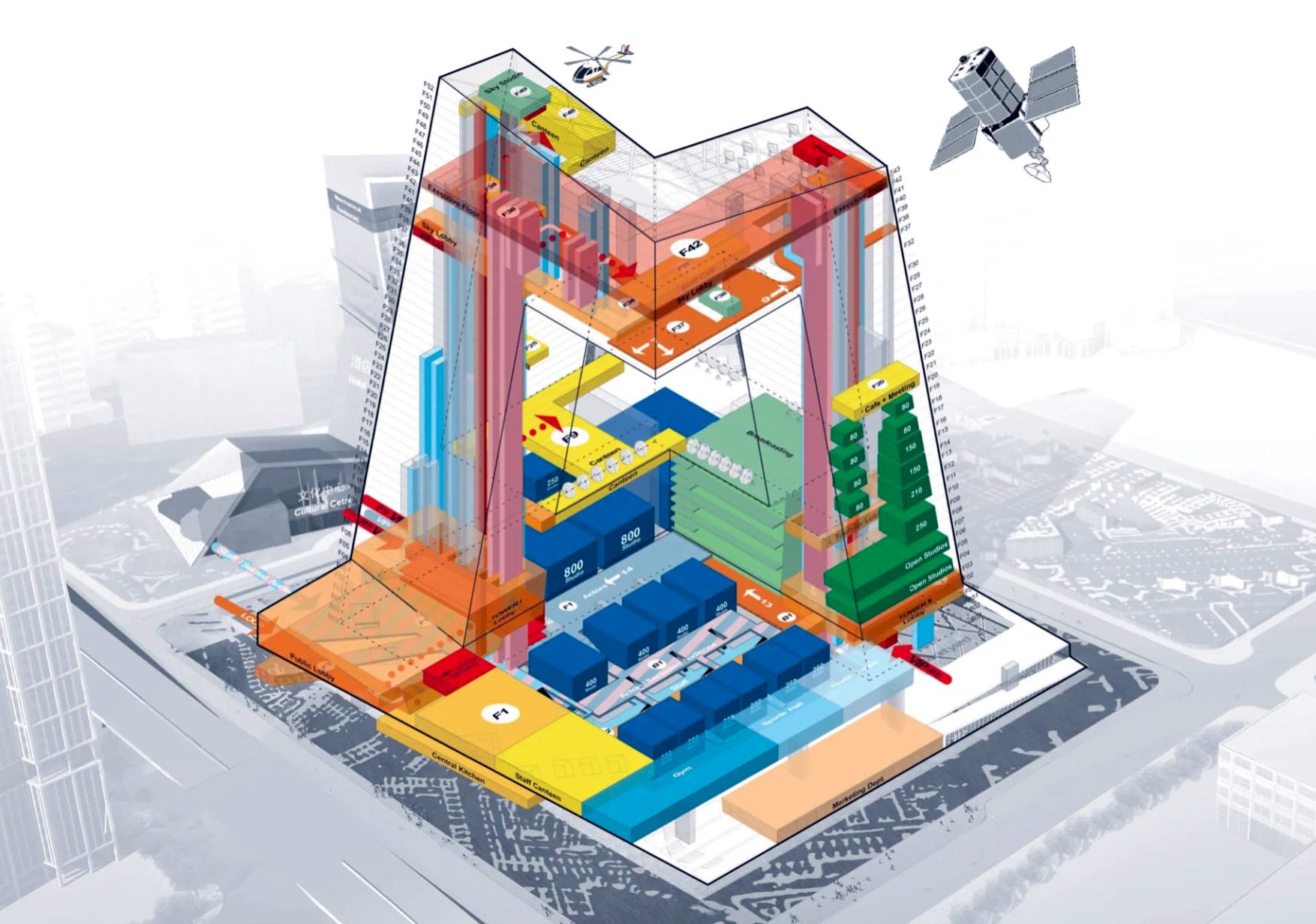
OMA’s programmatic diagram of its China Central Television (CCTV) Headquarters (2012) in Beijing is useful for my argument as an analogy to the 8 kinds of capital an architecture firm needs to quantify and track. Similar to the various kinds of capital that define a singular firm, this diagram illustrates how various elements need to come together and form a singular piece of architecture.
I find myself wondering what the equivalent number is in Canadian architecture. If you polled every registered practitioner in this country and asked them to honestly rate their firm’s design intelligence against their peers, the result would, I suspect, be similarly absurd. Eighty percent above average sounds about right. Possibly higher. We are, after all, a profession trained to inflate our egos.
Every architecture firm believes it is unique. This is, statistically, not possible. They may produce competent work. Some may produce excellent work. A genuinely small number produce work that is identifiably distinctive — work that could not have come from anywhere else. Or, simply put, work that shifts our understanding of architecture. But “unique” is a claim almost no one can substantiate, and yet almost everyone makes.
The problem starts with the language. “Unique value proposition” is the phrase the industry has settled on, and it deserves more scrutiny than it gets. Is what we sell truly unique? Often, the services of an architecture firm overlap considerably with those of the other three firms on a project's shortlist. And is an architect’s work truly valuable? Sometimes, but the claim of value is difficult to define. A valuable service might be a “good deal” to a client, especially if a firm low-balled their bid to get the job. On the other hand, isn’t a firm that charges an above-average fee really marketing itself as something “better” than the industry norm? A principal of a firm can convince herself that her fees are worth it because of the care and thought that goes into the design of the project. I’m sympathetic to that situation. I’m also sympathetic to a firm that complains about fees not being high enough, because if they somehow ran a leaner architecture firm, they would conceivably lack the technical, design, and political savvy to operate at the highest and most competitive levels. Ultimately, it just takes a lot of effort to be smart in architecture. It is also humbling to realize that being really smart is just the cost of keeping up. Staying ahead of everyone else is even harder.
I have spent the last several months building a framework that takes this gap seriously. I’m calling it Standing. Adapted from French sociologist Pierre Bourdieu’s understanding of the various forms of capital — and extended to suit the realities of Canadian public-sector procurement. This fascination of mine is a little tongue-in-cheek? After all, we were intellectually bathing in Bourdieu back in architecture school! But Bourdieu is an interesting inspiration for his work, which emphasizes how social classes, especially the ruling and intellectual classes, might preserve their social privileges across generations despite the myth — or even outright lie — that our contemporary post-industrial, late-stage capitalist society actually has us believe that equality of opportunity and high social mobility is actually achieved through formal education. So much for that RAIC Gold Medal you might have won upon graduation at the University of Waterloo.
As for my own examination of how to score a firm’s overall “capital” (social and otherwise), I have begun developing a process to assess a firm’s capital across eight dimensions: economic, cultural, social, symbolic, technical, political, cultural acuity, and narrative. Eight capitals, each with its own sources of legitimacy, each with its own method of compilation. If you’re still with me, think back again to architecture school when you had classmates who were really good at design, but the design lacked context — or even buildability. Other students excelled at technical competencies, even though their designs lacked vision — and most annoyingly, they rarely pulled an all-nighter before a crit. There were also the students who understood programming, or the ability to relate their work to a cultural zeitgeist. When running a contemporary practice, we need all of these people in an office. That, in effect, is why we also need to track eight dimensions of a firm’s overall “capital.”
The point of the exercise is not to flatter. It is to disaggregate. A firm that describes itself as “design-led, community-rooted, and sustainability-focused” describes, in some permutation, every architect’s website. Plus, they are making an undefended claim. The eight capitals split the claim. Where, exactly, is the design legitimacy? In what awards, in which publications, on which juries? Where is the community track record? Which First Nations benefitted, which equity-deserving partners were served, and over how many years? Where is the technical depth? In which certified buildings, with which post-occupancy data, with which embodied-carbon receipts?
It can be a frightening experience for most firms to undergo this process. It is not a traumatic experience for most firms to discover they are not unique, but it is quite a challenge for them to realize they are coherent in some areas of practice and incoherent in others. They are strong in technical capital and thin in narrative. Or rich in social capital and underdeveloped in the symbolic. Or — and this is the most common finding — entirely respectable across six of the eight capitals and unable to produce a single piece of evidence in the remaining two. This is normal! This is not only part of being human, but evolving as a firm.
Ironically, this process is actually what defines the uniqueness of each and every firm. This is not a failure. It is a portrait. And this is a far more useful structural process to build than what a firm’s marketing team can come up with because it tells the principal something actionable: not “are we unique” (almost certainly not) but “what kind of firm are we, and what kind of firm would we like to become?” The eight capitals also have the virtue of being testable and quantifiable. Awards are public. Project credits are public. Publications are searchable. Relationships, capabilities, and engagements can be inventoried. The only capital that resists external scrutiny is the “symbolic” — the capital your firm’s name signals to the outside world.
I suspect the resistance to this kind of audit will come from the firms that need it most. Practices with genuine distinction tend to be relaxed about evidence; their evidence speaks for itself. It is the firms living off rhetoric who object to having the rhetoric examined. I have a saying for this. I call the rims who live off rhetoric the “B-plus divas” for they are the firms that demand media and the world pay attention to their unique brilliance, whereas the firms that operate at the “A-level” are more readily understood for their uniqueness, their capital, for that matter, and even, dare I say, their “unique value proposition.”
OK. So, for argument’s sake, 80% of Canadian architects, on present trends, will continue to believe they are above average. That is human, and probably permanent. The value of a framework I like to use with my clients to understand the extent of their capital is the willingness to look at one’s own practice and ask: capital by capital, where is the proof, what can we improve upon, and what kind of firm do we wish to be?
The answer, in my experience, is almost always more interesting than the wish!
In the News…
Chodikoff & Ideas: Architecture firms that communicate clearly win more work. For more than 25 years, Ian Chodikoff has helped architecture and real estate firms find the words — and the strategy — to make their work matter to the people who need to hear it. I bring editorial acuity, institutional knowledge, and lateral thinking to every engagement. Whether you are a mid-sized firm trying to differentiate in a crowded market or a startup working to align climate-positive innovations with policy conversations, reach out to me so that I can help you communicate with precision and purpose.
Trends: How City Blocks Could Change for the Better (Azure) What will it take to make single-stair egress possible for small-unit buildings in urban areas? Conrad Speckert, a building code consultant and designer who serves on the single-egress task group at the Canadian Board for Harmonized Construction Codes, looks at recent progress across the country.
Federal Funding Backs 24 New Transitional Homes in Edmonton Under Reaching Home Strategy (CMHC) CMHC has announced financing for 24 new transitional housing units in Edmonton under the federal Reaching Home homelessness strategy, part of a growing emphasis on supportive housing as rental markets tighten on low-income tenants. The unit count is small, but transitional-housing pipelines are increasingly a preferred test bed for Indigenous-led and non-profit delivery models.
Ottawa to help build 1,100 rental units through Build Canada Homes (Future of Good) Ottawa affordable-housing approvals exceed the city’s initial federal target. The Ottawa package is important as a delivery story: the government said the eight approved projects surpassed its initial affordable-housing target by nearly 10%, suggesting that Build Canada Homes is being used not just as a policy banner but as a near-term approvals engine.
Delivering on Funding for Urban, Rural and Northern Indigenous Housing (Government of Canada) Indigenous housing funding points to BCH as a central project-finance platform. Because the Indigenous-housing announcement routes substantial capital through Build Canada Homes, it strengthens the view that federal project delivery is being centralized around BCH as a financing and implementation vehicle, not merely a grant channel.
PM announces eight affordable housing projects in Ottawa under Build Canada Homes program (Ottawa Business Journal) The announcement is notable less for Ottawa alone than for the model: federal land, flexible financing, and accelerated approvals packaged as a replicable delivery mechanism for mixed-income affordable housing.
Ottawa Commits $20.8M Through Affordable Housing Fund to Build 117 Homes Across British Columbia (CMHC) Canada Mortgage and Housing Corporation has confirmed $20.8 million in Affordable Housing Fund loans to deliver 117 new units across British Columbia, spanning a mix of non-profit and municipal operators. The tranche sits within the broader Build Canada Homes architecture but sharpens the question of whether targeted federal capital can move the needle faster than demand-side tools now dominating the policy debate.
Canada and Quebec Partner on $200M to Deliver 865 New Affordable, Supportive and Transitional Homes (Newswire/Canada.ca) Under a January 2026 Memorandum of Understanding, Ottawa and Quebec are jointly investing $200 million through Build Canada Homes to build 865 new affordable, supportive and transitional units — including 14 supportive projects totalling roughly 390 homes for people experiencing homelessness, fleeing violence, or living with complex mental-health needs. A new Joint Collaboration Table will streamline federal, provincial, and community approvals.
Kingston Penitentiary Could House Up to 700 Units — Including Lakefront High-Rises — Under Federal Land Bank Push (CBC News) Documents obtained by CBC reveal developers are proposing up to 700 housing units — including lakefront high-rises — for the decommissioned Kingston Penitentiary site, added to Ottawa’s Public Land Bank in January 2025. The pitch foregrounds the tension between acute housing need, heritage preservation, and Kingston’s reliance on the prison as a tourism and film anchor, signalling how contested federal surplus-lands strategies are becoming.
Toronto’s Multiplex Housing Push Hits NIMBY Snag as Committee of Adjustment Caseload Mounts (The Globe and Mail) The Globe reports that Toronto’s effort to scale multiplex housing is being slowed by Committee of Adjustment objections, neighbour deputations and mid-construction unit-expansion applications that are eroding public trust in the gentle-density program. The piece adds procedural context to the Council’s still-pending decision on whether to extend sixplex permissions citywide.
Toronto Allows Sixplexes in Downtown and Scarborough Neighbourhoods Under Multiplex Pilot Expansion (Ontario Construction News) Toronto Council has formalized sixplex permissions across the old City of Toronto, East York and Ward 23 in Scarborough, adding a 0.5-metre height allowance (to 10.5 m) and permitting up to four storeys of livable programme in a 3.5-storey envelope. Citywide expansion — tied to Housing Accelerator Fund milestones backed by a $471 million federal grant — is next up for a Council vote.
Etobicoke Fourplex Quietly Morphs Into Eightplex — Residents Cry ‘Gaming the System’ (Toronto Life) A Mimico property approved as a fourplex at 63 Station Rd. is now asking Toronto’s Committee of Adjustment to permit eight units mid-construction, with the planning consultant arguing the building envelope is unchanged. Neighbours warn the move would normalize post-permit unit creep citywide — a test case for how far Toronto’s gentle-density agenda can stretch before procedural backlash forces reform.
Storeys Year-Ahead Outlook: From Pause to Pressure-Test — Lenders Signal First Office-Budget Bump in Six Years (Storeys) Storeys’ annual industry outlook finds Canadian real estate shifting from pause to pressure-testing in 2026, with CBRE’s lender survey projecting the first rebound in office-loan budgets in six years and multifamily still leading lender intent. Economic weakness is cited by 74 percent of respondents as the top headwind, while the Bank of Canada’s 2.25 percent overnight rate is expected to hold steady.
How Canadian Developers Are Building for 2026: Rental Pivots, Smaller Suites and Standardized Assemblies (Storeys) This Storeys feature maps how Canadian developers are retrenching into purpose-built rental, phased delivery and cost-engineered product — smaller suites, standardized cladding assemblies, modular bathrooms — as condo pre-sales remain stalled. Developers interviewed flag construction-cost inflation and the timing of development-charge reductions as the two variables that will decide which projects actually break ground.
Delivering on Funding for Urban, Rural and Northern Indigenous Housing (Government of Canada) Ottawa said the funding will flow through Build Canada Homes to Indigenous housing providers, making this one of the clearest national housing-policy moves of the week and a significant signal about where near-term federal delivery is being prioritized.
A major housing development is in the works east of Toronto, but some are crying foul (City News) Pickering advances a secondary-plan scale expansion that could house more than 70,000 people. The proposal, heading toward a municipal vote, is being framed as a major growth and jobs strategy, but it is also drawing pushback over farmland loss and the pace of greenfield expansion, exactly the kind of planning conflict now defining housing delivery across the Greater Toronto Area.
Council approves people-first vision for Gastown (City of Vancouver) Vancouver council approves the Gastown Public Spaces Plan. The plan sets a people-first framework for future street and public-space investment in one of the country’s most sensitive urban heritage districts, blending mobility, placemaking, and heritage renewal rather than treating them as separate files.
Self-Storage Proposed for Former Hudson’s Bay Centre in Toronto (Retail Insider) Brookfield Properties has filed plans to concentrate retail space at grade while introducing self-storage uses on the upper levels of the existing podium building. Located at one of the busiest and most high-profile intersections in the country, the site sits on the edge of Toronto’s luxury retail corridor, anchored by the W Toronto, which is within the complex. The surrounding intersection is undergoing a broader transformation, with major projects and flagship retail on all four corners, including The One under construction, 1 Bloor East across the street, and a nearby Lululemon flagship. Against this backdrop, the introduction of a service-oriented use such as self-storage represents an unconventional approach for such a prominent, transit-connected location.