

Building the Impossible
A recently published book by the Neptis Foundation, entitled Impossible Toronto: On the Courtyard, calls for meaningful paradigm shifts in how we build our cities of the future.

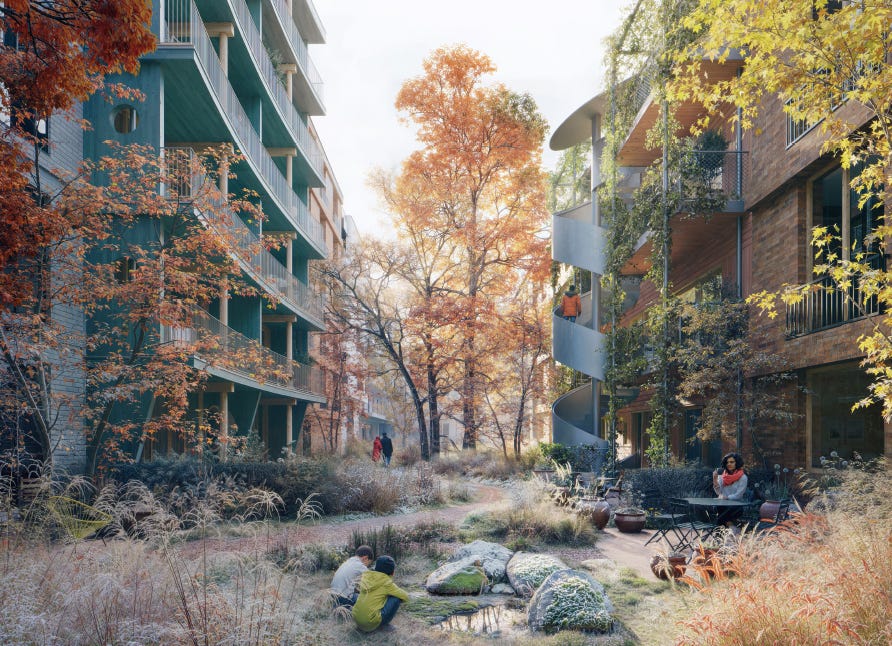
Envisioning a new typology triggered by modifications to planning guidelines, building codes, and housing policy could open up a whole new generation of housing typologies for Toronto and other Canadian cities that could meaningfully respond to our housing crisis. (Image Credit: Studio VAARO and Gabriel Fain Architects/The Neptis Foundation)
Toronto’s housing debate often reduces to “more supply, faster.” But what if we change the ways we build? Is that going to get us to the goal of building 500,000 new homes every year, promised by Mark Carney? This target includes the 4,000 modular homes the government plans to make to lower housing costs. Doubling the housing we need to build will take a decade to reach, notes Gregor Robertson, Minister of Housing and Infrastructure. And prefab construction is a speed tool, not a housing strategy. I am eagerly awaiting the Prime Minister’s budget on November 4th to see if the Federal government can truly “catalyze” (a term often used by Carney) a new housing industry at scale.
Meanwhile, a fascinating new book published by The Neptis Foundation is making a very positive impact on our industry. Impossible Toronto: On the Courtyard, written by Studio VAARO & Gabriel Fain Architects, argues for importing a proven European model: the mid-rise courtyard block—four to six storeys enclosing a generous, semi-public green court and a continuous street wall. It’s modest, neighbourly density that puts daily life first. The catch: it’s currently unbuildable here without significant rule changes associated with zoning and building codes. I think the proposition is fabulous because it shifts our thinking beyond the truly impossible tasks of persuading municipalities to reduce development charges and offer modest tax breaks under certain circumstances.
What makes the courtyard block different?
Unlike many Toronto mid-rises shaped by angular planes, deep setbacks, oversized cores and amenity/garbage rooms that eat into livable space, the courtyard block is deliberately simple: shallow floor plates, dual-aspect apartments (windows to street and court), minimal front setbacks, and a quiet interior commons for kids, neighbours and daily rituals. The result is better air, light and layouts—and a walkable street edge that feels like a city, not leftover space.
The team looked to Basel, Vienna, Berlin, Copenhagen and Paris, choosing Basel as the closest analogue: similar block widths and rights-of-way; a tradition of incremental, block-by-block build-out; and units optimized for cross-ventilation and daylight.
Why is it “impossible” today?
Our codes and guidelines inadvertently force the construction of bulky, expensive, and often less livable midrise developments. Significant setbacks, unpopular angular planes, two means of egress with big stairs, stretcher-sized elevators, electrical equipment rooms and mandatory amenity/garbage spaces that penalize smaller projects. The City of Toronto’s EHON (Expanding Housing Options in Neighbourhoods), designed to expand opportunities for “missing middle” housing forms —ranging from duplexes to low-rise walk-up apartments —is a step forward. However, it’s limited in coverage and still retains key constraints—including a 19-metre cap that complicates timber construction and generous floor-to-floor heights.
Even if the rules loosen, small infill proformas remain infeasible under current regulations. The courtyard model is feasible if we remove or defer certain costs (development charges, parkland, land transfer), streamline utilities, reduce process time, and calibrate requirements to project scale.
From a policy perspective, as-of-right courtyard blocks on major streets and large interior lots, with minimal front/side setbacks and no angular planes, would dramatically recalibrate the cities. Permitting single-stair access for buildings up to six storeys with shallow floorplates would be more aligned with international practice. Relaxing amenity and garbage-room requirements for buildings under 30 units, allowing compact cores and encouraging mass-timber floor assemblies by adjusting floor-to-floor heights would drive real innovation. Other ideas include deferring or eliminating other charges because these developments have manageable green spaces and would offer family-sized units. Site plan exemptions and utility fast-tracks for projects within a defined gross floor area threshold would improve project feasibility (saving both money and time).
The seemingly wild proposal to build a new courtyard typology could be further de-risked if built on public land. Pilot projects could demonstrate the typology at the block scale. Alternatively, building on deeper lots or a rear laneway block first could add to the success of initial prototypes.
To speed up the establishment of a new design typology, publishing open source “Courtyard Block Standards,” complete with studied maximum floorplate depths, cross-ventilation targets, daylight factors, single-stair dimensions, courtyard proportions, balcony and winter-garden strategies, rainwater and tree-soil specs, and storefront modules that keep the street lively would only bolster confidence among developers. Publishing a transition-aligned design brief (EUI caps, electrification, timber details) so lenders can treat courtyard pilots as climate-credible investments will further enhance this Neptis Foundation initiative. And pairing the courtyard typology with potential co-op ownership to make long-term care or kid-friendly commons an operating principle might lean in on this new approach to housing. A single block can host independent seniors, family units, and a small care suite—shared gardens can become social infrastructure that combats isolation.
Why this matters
Toronto doesn’t just need more homes; it needs better homes that make streets humane and inner blocks sociable. Courtyard blocks deliver a new “space of appearance”—a place where neighbours cross paths, kids roam safely, and the sidewalk regains dignity.
The Neptis Foundation and its Impossible Toronto are pragmatic invitations to remove obstacles for dramatically increasing the possibility of producing more housing. If we align policy, delivery and design, what looks “impossible” becomes the obvious next chapter in Toronto’s housing story. With investor-driven towers sputtering, Toronto needs a parallel track: shallow-plan mid-rise that local lenders and mission-driven sponsors can actually underwrite.
In the News…
Chodikoff & Ideas empowers architects, developers, and civic leaders with strategic foresight. I help clients position themselves as thought leaders who shape more resilient, equitable, and sustainable communities. Reach out to me if you have concerns about how to keep your business relevant in today’s market, and how to cultivate leadership within your organization to stay competitive and relevant in today’s economy and political reality.
A Co-op Love Story (Toronto Life)
Co-op housing is making a comeback. For all the potential friction of sharing a mortgage with your neighbours, it can be a beautiful thing. Jan Champagne and Miriam Zachariah met, fell in love and merged their families in a co-op. Now they’re founding their own
The Real Estate Diviners (Toronto Life)
A discussion with real estate notables to discuss Toronto’s hot-button housing issues: the affordability crisis, the multiplex conundrum, the condo bubble and the future of rentals in a city obsessed with home ownership
Pathways to Competitiveness: How Transition Plans Can Help Canadian Businesses Compete and Grow (Business Futures Pathways) Business Future Pathways’ inaugural report outlines why climate transition planning is now essential for Canadian competitiveness and investment. In a world of accelerating change, climate disruption is one source of change that businesses can foresee—and prepare for. The report finds that transition plans deliver tangible business benefits: building internal capacity, strengthening strategy alignment and opening access to capital and markets. We are falling behind global peers. Other economies are advancing faster with clear policies and investor expectations for credible transition plans. A lack of consistent guidance is slowing progress. Canadian investors and companies need a shared, practical definition of what “credible” looks like.
Stark displays of sexism’ driving women out of architecture, report finds (The Guardian) Two decades after a seminal report on sexism in architecture, women are still abandoning the profession because of “toxic workplace cultures”, sexual harassment, long hours and unequal pay, according to a report from the Royal Institute of British Architects (the RIBA). Female architects still faced intractable barriers, including “long hours being glorified, an imbalance of power between employers and employees, lack of clear policies and proactive action, and stark displays of sexism within practices”, according to the RIBA Build It Together report, produced with the equality charity the Fawcett Society. A survey targeted at women working in architecture found that half of all female respondents had experienced bullying at work, a third had been sexually harassed and a majority felt their architecture career progression had been stymied by having children.
What Types of Senior Housing Are Available? (The New York Times) For older adults, deciding where to live can be challenging and overwhelming. Each type of senior housing offers different pros and cons. Plus, recent headlines have highlighted financial struggles at some communities, painting a bleak picture of the options. For her father-in-law, she found a geriatric care manager through a local social services organization. The social worker visited his home and assessed his physical and mental capacities. Afterward, the care manager recommended he relocate to a nearby assisted-living facility, predicting that it would ease his loneliness. He moved and spent his remaining days surrounded by friends and, eventually, a romantic partner. Here’s an overview of the main senior housing options, in order from least to most care and supervision.
How plans for a sprawling subdivision near Ottawa’s Greenbelt are dividing the city (The Narwhal) Tewin is a massive development for up to 45,000 people planned for forests and fields southeast of the capital city. A major Ontario developer, Taggart Group of Companies, is behind the project and has partnered with Algonquins of Ontario, which has promoted Tewin as an environmentally friendly example of Indigenous “economic empowerment.” Members of the Taggart family own a big portion of the land in the Tewin area. But Algonquins of Ontario was largely the face of the project back when they proposed adding it to the city’s urban boundary — meaning it could be connected to municipal services like water and sewers.
We built it, but now will we ride it? (Spacing) Metrolinx’s exhaustive testing of the Crosstown is, in part, about avoiding the disastrous opening of the Ottawa LRT, which failed almost immediately, and forced the provincial government to hold an inquiry about the causes. When the service finally goes on line, Metrolinx is said to be planning some kind of launch promotion, which will be supported by the city (details so far are scant). So, yes, making a good first impression for a city-defining piece of infrastructure is crucial. What I’m wondering about is how, or whether, the city and the TTC are going to build on the Crosstown’s technical reliability and the day one festivities in order to make it part of Torontonians’ travel habits. I’m not convinced that merely throwing open the (fare) gates will do the trick.
Running the City (Spacing) The Toronto Waterfront Marathon is more than a race. On an October Sunday each year, the marathon becomes a live experiment in how Toronto negotiates its public sphere – balancing logistics, safety, and movement all while giving runners and spectators a new way to experience the city. Chris Fagel is President/CFO of Canada Running Series, which organizes the marathon, and the longtime course director. Behind the scenes, the event relies on a web of cooperation between city departments, including planning, transit, emergency services, and traffic management.
Downsview redevelopment setting a course for new urban life (The Globe and Mail) Northcrest Developments is remaking the Downsview Airport lands into a new district called YZD, converting the remnants of aviation into a framework for civic life. A look at the $30-billion eco-friendly neighbourhood being built in Toronto over three decades This matters to the city and the country because the site is large and unusual enough to play a major cultural role. Northcrest recently named the American landscape architects Michael Van Valkenburgh Associates (MVVA) to lead the next stage of the transformation.
Three real estate markets bucking national and regional trends (The Globe and Mail) The Canadian real estate market remained sluggish in September, but some communities across the country bucked the trends of national or even regional markets. The growth of national real estate prices has been flat for months, according to data from Wahi, a digital real estate platform, and Real Property Solutions, a Canadian property valuation service provider. Condos remain the largest factor in stagnant property prices, as their values dropped by 6 per cent nationally in September.
Canada’s modular housing industry may not be able to meet Carney’s ambitions (The Logic) With its angular design, brightly coloured accents and jet-black facade, the 56-unit apartment building at 150 Eighth St. in the Toronto neighbourhood of Etobicoke looks much like many new housing complexes in the country’s biggest city. Yet because much of it was manufactured off-site then Lego’ed together with cranes, its roughly 62,000 square feet will be built as much as six months faster than a traditional build. Modular housing units like 150 Eighth St. are increasingly seen as the solution to the country’s chronic shortage of places to live. Build Canada Homes, the new $13-billion federal agency the government has tasked with increasing the country’s housing stock, is relying heavily on prefabricated construction methods to fulfill the anticipated need for nearly 5 million new homes over the next decade to restore affordability to 2019 levels. The reasoning is simple: its proponents argue that modular housing can be delivered to market comparatively quickly and cost-effectively.
Why these three Canadian cities top the U.S. in housing inflation (The Globe and Mail) As of 2025, Vancouver and Toronto rank as the first and third most unaffordable metropolitan areas among the 25 largest metropolitan areas in North America. The question is whether these cities have always been costly, or whether the surge in housing prices – or lagging income growth – pushed them further behind. The data reveal that population growth is a secondary factor. The population of Charlotte, N.C., nearly doubled, while Montreal’s rose only 23 per cent, yet Montreal’s housing prices climbed far more dramatically.
The New Condo Market in the GTA (Urban Toronto) The Greater Toronto Area’s new condominium market has long been the subject of heated debate. For years, critics have railed against investors, arguing that their purchases of pre-construction units drive up prices, crowd out end-users, and reduce affordability. The logic seems simple: if fewer investors bought, more homes would be available to people who actually want to live in them. But the truth is far more complicated. Investors have been the linchpin of the GTA’s high-rise housing delivery system. Many of you wanted to get rid of them via policy, but the market has now done that, and we now face the unintended consequence of diminished housing production.
Solar and wind outpaced demand growth as renewables overtook coal in the first half of 2025 (Ember) The increase in solar and wind power outpaced global electricity demand growth in the first half of 2025. Solar alone met 83% of the rise, with many countries setting new records. Fossil fuels remained mostly flat, with a slight decline. Fossil generation fell in China and India, but grew in the EU and the US. As the world’s energy needs increase and electricity makes up a growing share of final energy consumption, spectacular solar growth, alongside increased wind generation, met and exceeded all new demand. This led to renewables overtaking coal’s share in the global mix and prevented further increases in CO2 emissions from the power sector.
Dense, compact urban growth is favoured by mid-sized Canadian cities (Building) Canada’s mid-sized cities — those with populations between 50,000 to 500,000 — have long been characterized as low-density, dispersed and decentralized. In these cities, cars dominate, public transit is limited and residents prefer the space and privacy of suburban neighbourhoods. Several mounting issues, ranging from climate change and the housing affordability crisis to the growing infrastructure deficit, are challenging municipalities to rethink this approach. Cities are adopting growth management strategies that promote density and seek to curtail, rather than encourage, urban sprawl. Key to this is intensification, a strategy that prioritizes adding new housing in existing and mature neighbourhoods instead of outward expansion along the city’s edge. City centres are often central to intensification strategies, given the abundance of vacant or underused land. Adding more residents supports downtown revitalization efforts, while simultaneously curbing urban sprawl.
How high is too high for Vancouver’s social housing projects? (Construction Connect) The City of Vancouver is updating its social housing initiative. The purpose is to accelerate the delivery of non-profit-led social and co-operative housing in the city by streamlining the development process. The initiative, which was just released, reflects feedback from the public and stakeholders in late 2024. Planners are recommending that almost one-third of Vancouver be zoned for social housing highrises up to 20 storeys high. That includes large sections of the long-established neighbourhoods of Kitsilano, Marpole, Killarney, Champlain Heights, central Main Street, Point Grey, Dunbar, East Hastings Street and Commercial Drive. The initiative also proposes adding social-housing apartment blocks of up to six storeys in another one-fifth of the city. It would mean automatic approval of at least three types of social-housing highrises: Mixed-income, co-operative housing and supportive housing, where onsite services are provided to marginalized people. Eligible projects would still need to get a development permit, which includes, in most cases, notifying surrounding properties and neighbourhood groups and collecting public comments on the proposal.
"Toronto doesn’t just need more homes; it needs better homes" - I completely agree, having lived in a courtyard block in Amsterdam several years ago. Thank you for amplifying this message, Ian! It's incredibly important.
One additional factor to consider to increase feasibility: fast-track approvals for mid-rise of all types, especially courtyard blocks. The current approvals process requires these projects to undergo the same level of scrutiny as a 60 storey tower. Paired with features such as single stair, fast-track approvals would deliver the efficiency + certainty that developers need to make this typology a reality.