Re-drawing the Commons
The recent visit by King Charles III helped re-assert Canada's traditions, legacy and global-facing posture. Next on the agenda? Use a national architectural policy to re-invent our traditions.
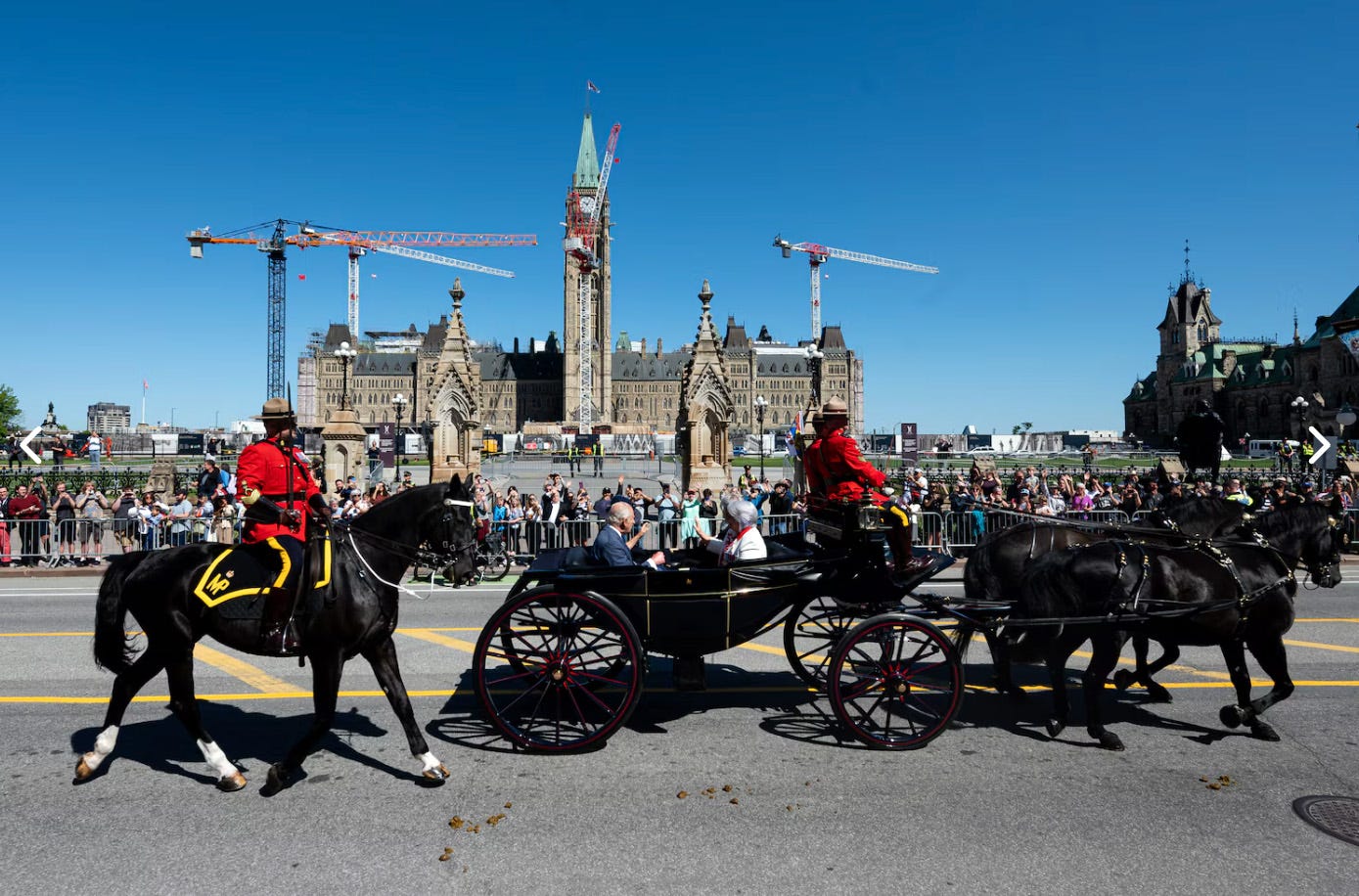
Amidst pomp, circumstance and well trained-horses, King Charles III’s visit to Ottawa this week could signal a new chapter for Canada to literally build (and re-build) our traditions in the shape of new cities and design excellence in architecture.
Last week, a London judge called Lambeth Council’s approval of month-long music festivals in Brockwell Park “irrational,” chastising planners for fencing off a Victorian commons for 37 straight days. The ruling split the city: were activists preserving public space, or throttling a shared cultural economy? Either way, the case exposed the fragility of a resource we assume will always be there: open, democratic public land. When we treat the public realm as an afterthought, the void quickly fills with inequity, commercialization, or decay.
Canada faces a similar fragility—only ours is spread across libraries, museums, streets and theatres, all built piecemeal without a unifying vision. With a new Liberal government under Prime Minister Carney, there is a renewed opportunity for a national architecture policy that could bring about a new era of building architectural and urban design legacies for Canada. But a national architectural policy--should one ever be created--will need to bring together disparate issues such as rising construction costs, lengthy approvals processes, the need to realign the supply chain for construction, encourage prefabricated and modular construction, and lower interprovincial trade barriers as this country seeks to re-assert our international-minded trade policies. This list of concerns is already a tall order in a world where the lowest bid often wins the project, and design excellence is either an afterthought or a matter of luck.
Why architecture policy is the keystone
Canada once understood this, especially during the late 1960s, when we had a building program celebrating our Centennial, along with a general fervour to create long-lasting legacies, often turning tax dollars into the National Arts Centre, Habitat 67, and the Ontario Science Centre.
Today, procurement favours lowest-cost compliance, and the Ontario Science Centre fiasco is indicative of reducing such national cultural landmarks to rubble for the sake of a few residential highrise properties. important buildings
Imagine a world where minimum design and carbon-performance standards are set for any project receiving federal funding—mirroring how Denmark and Finland leverage design quality as a form of soft power. Imagine if we mandated whole-life costing, so municipalities stop accepting the cheapest envelope today and paying triple operating costs tomorrow. And what about protecting cultural and scientific landmarks? The political whimsy and lack of transparency by our current Ontario provincial government should trigger procedural safeguards that include requiring transparent, arm’s-length assessments before disposal or demolition.
Effective policy can become the scaffolding that lets communities debate how to use a park or a museum without wondering if it will still exist next year.
Parks as the democratic living room
Brockwell Park’s dispute may seem distant, yet Canadian cities are heading down the same path. Cash-strapped councils rent out green space for marathons, winter carnivals, and even glamping pods. These events generate revenue but erode the idea of an always-open commons.
A robust architecture (or broader public-realm) policy could treat parks as civic infrastructure—subject to capacity studies, ecological “rest days,” and inclusive programming targets—rather than as blank balance-sheet assets. User fees might still exist, but they would be calibrated against the social value of free access, not just fiscal need.
A national architecture policy could be Canada’s opportunity to articulate a right to the designed city: a promise that every resident can reach a dignified, inspiring public space without financial, physical or cultural barriers. In practice, that means aligning cultural space funds with transit equity plans. It means treating parks as climate-resilience infrastructure worthy of ecological baselines and restorative downtime. It means re-professionalizing public procurement, so architects, planners and landscape designers can champion quality over expediency without sacrificing accountability.
If we want cities that feel generous rather than gated, we must design—and demand—them. Policy is simply the blueprint; the lived city is up to us.
Thanks for reading. If this resonates, forward it to a friend and join the conversation.
In the News…
Chodikoff & Ideas empowers architects, developers, and civic leaders with strategic foresight. I help clients position themselves as thought leaders who shape more resilient, equitable, and sustainable communities.Reach out to me if you have concerns about how to keep your business relevant, how to communicate your particular value proposition in today’s market, and how to cultivate leadership within your organization to stay competitive and relevant in today’s economy and political reality.
Building Better Policy
Publicly owned cultural spaces in Canada (Hill Strategies) According to a recently released Statistics Canada survey, there are 5,376 arts, culture, and heritage spaces in Canada that are owned by municipal, provincial, and federal governments. Libraries are the most common publicly owned arts, culture, and heritage spaces in Canada, followed by museums and archives, performing arts facilities, art galleries, and Indigenous culture facilities. The 5,376 arts, culture, and heritage spaces in Canada include 2,825 libraries (53% of all cultural spaces), 1,496 museums and archives (28%), 628 performing arts facilities (12%), 343 art galleries (6%), and 84 Indigenous culture facilities (2%).
What are public parks for? Inside the debate sparked by London festival row (The Guardian) What are public parks for? Public parks have been a cherished part of British life since the 19th century; for the Victorians they represented a “commitment to cultivate public good within the public realm”. But differing interpretations of this vision for municipal green space are at the heart of a debate over a very 21st-century issue: music festivals. The row over mass music gatherings in Brockwell Park injected fresh impetus into some age-old questions: what are public parks for, who should have access to them, and for how long?
Canada needs an architecture policy (The Globe and Mail) Canada lacks a national architecture policy guiding design decisions that shape social infrastructure. Reflecting on Centennial-era investments that produced beloved civic landmarks, the article argues for a framework setting accountable goals for inclusive, sustainable buildings, landscapes, and transportation. Such a policy could address aging assets, cultural identity, and economic vitality.
Why Planners and Policymakers Must Address Structural Barriers to Mobility (Next City) Portland’s planning history is rooted in exclusionary laws that marginalized Black residents through redlining, displacement, and disinvestment. The article argues mobility policies must confront these structural injustices, ensuring transportation investments prioritize historically harmed communities. Addressing racism in land use, housing, and transit funding is essential for equitable opportunity and access.
New documents reinforce that Science Centre closure was not supported by engineers (Canadian Architect) Freedom-of-information releases reveal draft Rimkus engineering reports advised maintaining the Ontario Science Centre’s RAAC roofs, not closing the landmark. Correspondence suggests government pressure influenced the final June 2024 report recommending shutdown. The revelations intensify scrutiny of political motives, transparency, and preservation planning for one of Toronto’s most significant modernist institutions today.
How Canada can turn tariff tensions into a global affordable housing alliance (Building) U.S.–Canada steel and aluminum tariffs threaten housing affordability by inflating construction costs. The commentary proposes forming an international alliance focused on bulk purchasing and shared innovation in low-cost, low-carbon building materials, offsetting tariff impacts. Leveraging collective demand could lower prices, accelerate 3.5-million-home targets, and foster climate-aligned industry collaboration across nations.
How Far Will Carney’s $26B Prefab Promise Get Us In A Housing Crisis? (Storeys) Prime Minister Mark Carney’s Build Canada Homes plan pledges $26 billion to boost prefabricated construction, touting 50 percent faster builds and 20 percent cost savings. Analysts applaud support for mass timber and apprenticeships but question capacity constraints, supply-chain readiness, and policy follow-through. Success hinges on scaling factories quickly and integrating modular units into municipal approvals processes.
Ontario unveils plans it says will speed up housing, transit construction (The Globe and Mail) Ontario’s new bill expands powers to mandate dense transit-oriented communities and limits municipal study requirements before approvals. Housing Minister Rob Flack says reforms, paired with $400-million infrastructure grants, will accelerate homebuilding and transit projects. Critics warn curtailed local oversight could weaken environmental review, public consultation, and affordability outcomes for residents overall.
Building the Low-Altitude Economy (Urban Land) China is aggressively developing a “low-altitude economy” where drones and electric vertical-takeoff aircraft handle deliveries and commuting. Government policies, urban-airspace planning, and prototype neighborhoods envision rooftops as logistics hubs and vertiports. The article explores market potential, regulatory hurdles, and lessons for cities worldwide preparing for on-demand, zero-emission aerial mobility services.
Car-free streets, geothermal heating and solar panels: Paris’s new eco-district (The Guardian) The site is home to several ambitious and high-profile architecture projects, including the Paris courthouse, which was designed by the Renzo Piano Building Workshop.
Thunder Bay is bringing its Great Lake shoreline back (The Narwhal) Thunder Bay’s formerly industrial Lake Superior shoreline, degraded by decades of pulp-and-paper pollution, is undergoing an ambitious ecological restoration. Government funds and community partners are removing contaminated sediments, reshaping wetlands, and re-establishing native species. The project seeks to delist the area of concern, revive fisheries, and reconnect residents with clean waterfront.
Development News
Metrolinx partnership to offer ‘faster, more frequent’ train service ends 2 decades early (Global News) Metrolinx has terminated its 34-year contract with ONXpress, the Deutsche Bahn–Aecon consortium hired in 2024 to operate and modernize GO Transit. Scheduled to begin service in 2025, the partnership promised electrification and improved frequency. Ending the deal 20 years early raises questions about project timelines, governance, procurement strategies, and provincewide accountability.
Is a buyer's market emerging in Vancouver real estate?(BIV) Vancouver’s housing inventory is rising as interest rates stabilize, nudging the condo and detached markets toward buyer advantage. Analyst Adil Dinani notes tariff anxieties and election uncertainty briefly cooled demand, creating negotiation leeway. Observers caution the window may close if a new U.S. trade deal or rate shifts revive competition soon.
Culture and Inspiration
Out of the Wild: How A.I. Is Transforming Conservation Science (Yale Environment 360) Researchers are leveraging artificial intelligence to analyze massive wildlife audio repositories, extracting elusive species’ calls previously impossible to review manually. In Alberta’s boreal forest, algorithms comb 99 percent of recordings, revealing insights into nocturnal nighthawks and other understudied animals. AI promises faster biodiversity monitoring, better habitat management, and proactive conservation decisions.
Canada’s Picoplanktonics Brings Poetic Biology to Venice (Azure) At Venice’s Architecture Biennale, Canadian collective Picoplanktonics converts the national pavilion into a moist, biotechnological terrarium. Nine misted tanks host lattice structures seeded with microalgae, inviting visitors to contemplate symbiosis, climate adaptation, and speculative futures. The multisensory installation contrasts textual overload elsewhere, offering an evocative, living metaphor for planetary stewardship.
Round-up: Canadian-led exhibitions at the 2025 Venice Biennale (Canadian Architect) Beyond the official Canada Pavilion, 2025’s Venice Biennale features Canadian talent across collateral exhibitions. The article surveys designers participating in Carlo Ratti’s central “Intelligens” show, university research installations, and independent showcases exploring topics from mass-timber circularity to Arctic housing. Collectively, these contributions highlight Canada’s design influence, sustainability leadership, and cultural diversity.
The cabinet of civic wonders (some assembly required) (The Globe and Mail) Toronto’s long-neglected civic artifact collection—containing Indigenous arrowheads, wartime relics, and cultural ephemera—may finally gain a public home in vacant Old City Hall. Advocates imagine galleries and civic-memory programming enlivening the 1899 landmark, complementing court conversion plans. Realizing the museum vision could deepen residents’ historical connection and downtown revitalization efforts significantly.